Leonardo Da Vinci Medal
Academic Award of the IDEA League
Recognition of excellence in mathematics and creative engineering, in continuity with the historic Prix Poncelet (1868-present)
Preserving Excellence Since 1868
The Leonardo Da Vinci Medal is the academic award of the IDEA League, created to recognize excellence where mathematics, engineering, and technical creativity intersect.
Its creation is based on a collective academic decision: to update and continue the historic Prix Poncelet, established in 1868 by the Académie des Sciences de France, considered the first European prize dedicated to rewarding the application of mathematics to engineering.
This new framework does not simply replace one prize with another, but recovers a dormant legacy to project it coherently into the 21st century. The Leonardo Da Vinci Medal and the Prix Poncelet thus form a single line of historical continuity, linking two centuries of technical and scientific thought with a modern, interdisciplinary, and university-based European approach.

What We Recognize
Four pillars of excellence in mathematical engineering
Mathematical Excellence
Outstanding contributions in mathematical theory applied to engineering challenges
Creative Engineering
Innovative solutions that demonstrate exceptional technical ingenuity and originality
Technical Impact
Work that advances the field and creates lasting value for engineering practice
Interdisciplinary Impact
Work that bridges multiple domains and advances technical knowledge
A Bridge Across Centuries
From Renaissance genius to modern mathematical rigor
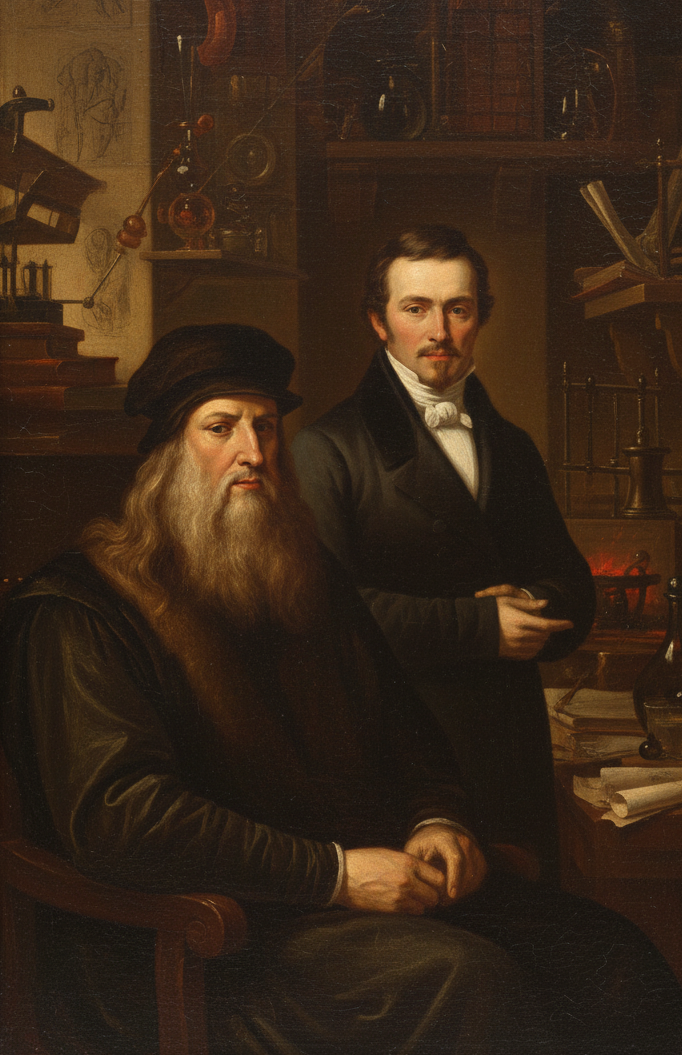
Two Minds, One Vision
Leonardo da Vinci (1452-1519) and Jean-Victor Poncelet (1788-1867) lived centuries apart, yet they shared a profound conviction: that mathematical reasoning and engineering practice are inseparable facets of human innovation.
Da Vinci, the quintessential Renaissance polymath, approached engineering through the lens of geometric principles. His notebooks reveal a mind that saw mathematical patterns in nature and translated them into mechanical designs—from flying machines to hydraulic systems. For Leonardo, engineering was applied geometry, and geometry was the language of creation.
Three centuries later, Poncelet would formalize this intuition into a rigorous mathematical framework. His pioneering work in projective geometry provided engineers with powerful tools to solve problems that had resisted purely empirical approaches. Poncelet demonstrated that abstract mathematical concepts could unlock concrete engineering solutions.
The Common Thread
Both men understood that true innovation emerges at the intersection of theory and practice. Da Vinci's genius lay not just in his artistic vision, but in his ability to ground fantastical ideas in geometric reality. Poncelet's contribution was to show that mathematical abstraction, far from being divorced from practical concerns, could be engineering's most powerful ally.
The Prix Poncelet, established in 1868—one year after Poncelet's death—explicitly recognized this synthesis. It honored those who, like its namesake, advanced engineering through mathematical innovation. The prize rejected the false dichotomy between pure mathematics and applied engineering, celebrating instead their productive union.
A Legacy Renewed
The Leonardo Da Vinci Medal continues this tradition with deliberate purpose. By invoking both names—Leonardo's Renaissance vision and Poncelet's mathematical rigor—the award affirms that the challenges of the 21st century demand the same integration of creativity and precision that characterized both men's work.
Today's complex systems—from climate modeling to autonomous infrastructure—require engineers who can move fluidly between abstract mathematical frameworks and concrete physical realities. The Medal recognizes those rare individuals who, like Da Vinci sketching the laws of fluid dynamics or Poncelet revolutionizing geometric analysis, refuse to separate the elegance of mathematical thought from the urgency of engineering problems.
In honoring the Prix Poncelet's legacy while embracing Leonardo's name, the award declares that the spirit of mathematical engineering—rigorous, creative, and indispensable—remains as vital today as it was in Renaissance Florence or 19th-century France.
"The noblest pleasure is the joy of understanding." — Leonardo da Vinci
Explore the Legacy
Discover the complete history of laureates, selection criteria, and the mission of this prestigious European academic award